Graceful Refusal: The Diplomatic Art of Saying No That Leonardo Perfected—and Modern Creators Desperately Need
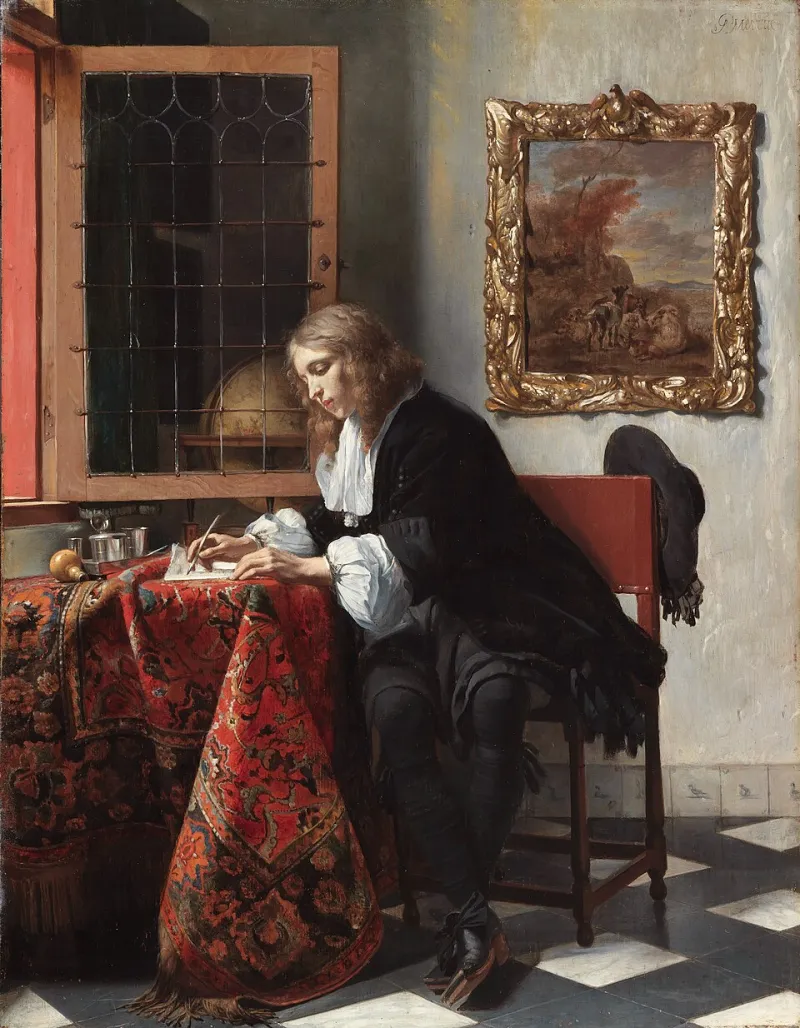
Photo: Gabriel Metsu, Public domain, via Wikimedia Commons
The attention economy runs on a single operating assumption: that availability is a form of respect, and that declining a request is a form of aggression. Creators, freelancers, and artists working in the United States today are drowning in this logic—buried under collaboration requests, speaking invitations, commission inquiries, and the ambient pressure to remain perpetually responsive. The result is a creative culture that mistakes busyness for productivity and confuses access with generosity.
Leonardo da Vinci operated in a world where the stakes of refusal were considerably higher. A misjudged rejection could mean the loss of a patron's protection, a damaged reputation in a small and gossipy court, or worse. Yet the historical record shows a man who declined commissions with remarkable consistency—and who, through the careful architecture of his refusals, often deepened the very relationships he was declining to serve.
The Patron Relationship as a Delicate Instrument
To understand how Leonardo refused, it helps to understand what he was refusing within. Renaissance patronage was not a transactional marketplace. It was a web of obligation, loyalty, and mutual prestige in which artists and their patrons were bound together by something closer to a feudal contract than a modern client agreement. To reject a commission outright was to risk being read as ungrateful, arrogant, or—perhaps most damaging of all—unreliable.
Leonardo navigated this system with a sophistication that his correspondence makes legible. His letters to Ludovico Sforza, to Isabella d'Este, and to various Florentine intermediaries reveal a consistent strategy: he never said no to the person. He said no to the timing, to the scope, to the conditions—leaving the door open in a way that honored the patron's ego while quietly protecting his own calendar.
When Isabella d'Este pressed him repeatedly for a portrait, Leonardo did not refuse her directly. He expressed admiration for the commission, acknowledged the honor of her request, and then—with exquisite vagueness—described the various obligations and complexities that currently prevented him from giving her work the attention it deserved. He sent a preliminary sketch as a gesture of good faith. The portrait was never completed. Isabella was disappointed but never alienated. She continued to correspond with him warmly for years.
The Anatomy of a Diplomatic Refusal
Breaking down Leonardo's method reveals several consistent elements that modern creators would do well to study carefully.
Elevation before deflection. Leonardo rarely opened a refusal by discussing his own constraints. He began by acknowledging the value of what was being asked—the importance of the patron, the worthiness of the project, the distinction it would represent. This was not mere flattery. It was a structural move that reframed the refusal as a matter of circumstance rather than preference.
Specificity of obstacle, vagueness of timeline. He was precise about why he could not act now—existing obligations, the demands of a current project, the need to give the work the time it deserved—while remaining deliberately imprecise about when he might be available. This kept the relationship in a state of productive suspension rather than closing it down entirely.
The partial gesture. In many cases, Leonardo offered something in lieu of the full commission: a sketch, a recommendation of another artist, a written description of how he would approach the work if circumstances allowed. These gestures served a dual function—they demonstrated genuine engagement with the request while making clear, without stating it directly, that full execution was not forthcoming.
The appeal to shared standards. Perhaps most cleverly, Leonardo occasionally framed his refusal as an act of respect for the patron's own discernment. To rush a work, to produce it under unfavorable conditions, would be to deliver something beneath what the patron deserved. The refusal, in this framing, became a compliment.
Why This Matters More Than Ever
The dynamics Leonardo navigated have a striking contemporary resonance. Today's creative professionals exist in an ecosystem where every declined collaboration, unanswered pitch, or passed-over invitation carries social and algorithmic consequences. Social media has made professional relationships simultaneously more visible and more fragile. A public or poorly worded refusal can damage a reputation in ways that would have been unimaginable in a Sforza court—but the underlying psychology of the person being declined has not changed at all.
What Leonardo understood—and what most modern productivity advice misses entirely—is that a refusal is not a transaction. It is a relationship event. The way you decline something tells the other party something important about how you see them, how you see yourself, and how you prioritize the connection between you. A flat, efficient no may be honest, but it is rarely wise.
Boundary-Setting as Reputation Architecture
There is a deeper point embedded in Leonardo's practice that deserves direct attention: his refusals were not defensive maneuvers. They were reputation-building acts. Each carefully managed decline reinforced the impression that his time was genuinely scarce, that his standards were genuinely high, and that when he did commit to a project, the commitment meant something.
This is the counterintuitive logic that the attention economy consistently inverts. The assumption that availability signals value produces the opposite effect over time. When everything is accessible, nothing is precious. Leonardo's consistent scarcity—whether calculated or simply the natural result of his ambitions—made each acceptance feel like an event.
For creators working in any medium today, the strategic lesson is not to manufacture false scarcity or to perform unavailability as a brand tactic. It is to take seriously the idea that how you decline shapes what you are invited to accept. A graceful refusal, delivered with genuine warmth and clear respect for the person asking, does more for a professional relationship than a reluctant yes ever will.
The Letter Leonardo Never Sent
There is, of course, a version of this story that is less flattering. Leonardo's diplomatic refusals sometimes shaded into evasion. His inability to simply say yes—and mean it—left a long trail of unfulfilled promises and incomplete works. The same instinct that made him a graceful decliner also made him an unreliable deliverer.
The lesson, then, is not to replicate Leonardo wholesale. It is to borrow his diplomacy while building the follow-through he often lacked. The art of saying no beautifully is only valuable when it is paired with the discipline to say yes rarely and mean it completely.