The Power Beneath the Surface: Leonardo's Hidden Engineering and the Art of Governing Without Spectacle
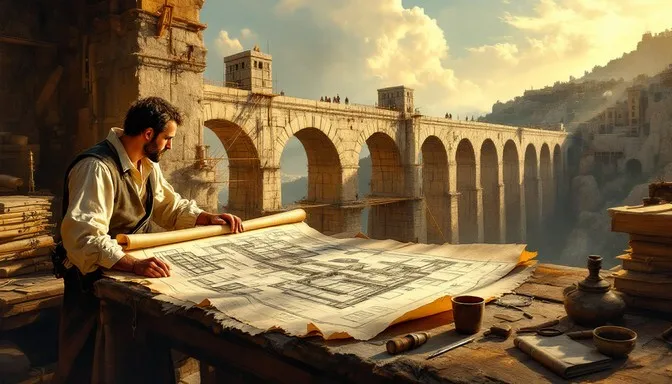
Photo: Renaissance engineering blueprints canal system fortification historical maps Italy, via images.stockcake.com
The image of Leonardo da Vinci that dominates popular imagination is a solitary one: the artist at his easel, the theorist filling notebooks by lamplight, the visionary sketching flying machines that no craftsman of his era could build. This image is not false, but it is radically incomplete. It omits the Leonardo who spent years designing canal systems for Ludovico Sforza, who drew detailed fortification plans for Cesare Borgia during a military campaign across central Italy, who proposed comprehensive schemes for the redesign of Milan's streets following an outbreak of plague.
This other Leonardo—the engineer of invisible infrastructure, the advisor who shaped political outcomes without seeking public credit—offers a model of consequential action that has become almost unthinkable in an age when leadership is increasingly indistinguishable from performance.
Engineering as Political Instrument
The relationship between Leonardo and Ludovico Sforza, Duke of Milan, is most frequently described through the lens of artistic patronage: the duke commissioned paintings, Leonardo delivered some and delayed others, and the arrangement produced the Last Supper. But the actual scope of Leonardo's engagement with the Sforza court was far broader and, in many respects, more politically significant than any painting.
Leonardo spent the better part of nearly two decades in Milan working on hydraulic engineering projects that were fundamental to the duchy's agricultural economy and military capacity. The canal systems he designed—expanding and refining the navigli network that connected Milan to surrounding waterways—were not decorative achievements. They determined how goods moved, how armies were supplied, and how the duchy managed the relationship between urban and rural populations. Control of water, in Renaissance Lombardy, was a form of governance.
Leonardo understood this. His notebooks from the Milan period contain hydraulic calculations alongside architectural drawings alongside notes on the political geography of the Po Valley. He was not merely solving engineering problems. He was thinking about how physical infrastructure shaped the distribution of power, and he was doing so in the service of a patron who had every reason to keep such thinking quiet.
The Strategic Value of Invisibility
For Cesare Borgia, the ruthless military commander whose campaigns across Romagna and Tuscany in the early sixteenth century briefly made him one of the most feared men in Italy, Leonardo served as a military engineer and cartographer. He produced maps of extraordinary precision—including a famous aerial-perspective rendering of the town of Imola—that gave Borgia a strategic intelligence advantage over adversaries who were still working from crude, distorted representations of the same terrain.
What is striking about this episode is not the cartographic achievement itself, remarkable as it was, but the manner in which Leonardo's contribution functioned within Borgia's overall strategy. The maps were not published, displayed, or attributed. They were operational instruments, kept close, used to make decisions that appeared to contemporaries as the product of Borgia's intuition or military genius. The engineer's work disappeared into the commander's reputation.
This dynamic—in which the most consequential intellectual labor is structured to be invisible to the public record—represents a form of power that is genuinely difficult for contemporary Americans to parse. American political and business culture has been shaped by a deep commitment to visibility as a measure of significance. The person who is seen is assumed to be the person who matters. The advisor, the architect of infrastructure, the designer of systems—these figures are perpetually undervalued because their work does not photograph well.
Urban Redesign and the Long Game
Perhaps the most ambitious of Leonardo's invisible projects was his proposal for the redesign of Milan following the plague of 1484 and 1485, which killed roughly one-third of the city's population. Leonardo's scheme—developed in considerable detail in his notebooks—called for the construction of a network of smaller, decentralized cities that would redistribute Milan's dense urban population across the surrounding region, reducing the conditions that allowed epidemic disease to spread.
The proposal was never implemented. Ludovico Sforza was not prepared to undertake the political and economic disruption that such a redesign would have required. But the exercise itself reveals something important about how Leonardo conceived of his engineering work. He was not designing solutions to discrete technical problems. He was modeling entire systems—thinking about how the arrangement of physical space shapes the behavior of populations over generations.
This is long-game thinking of a kind that is structurally discouraged in contemporary American governance, where electoral cycles create powerful incentives to favor visible, short-term interventions over the kind of patient infrastructure investment that produces its most significant effects only after the current administration has left office.
What Modern Leaders Are Missing
The contrast between Leonardo's model of consequential invisibility and the performance culture of contemporary American leadership is not merely aesthetic. It reflects a fundamental disagreement about what leadership is for.
The current environment—shaped by social media, the twenty-four-hour news cycle, and a political economy that rewards attention over effectiveness—treats visibility as the primary currency of influence. Leaders are expected to be constantly legible, their every decision narrated in real time for an audience whose attention is the ultimate measure of significance. The result is a systematic bias toward actions that can be seen and credited over actions that actually work.
Leonardo's engineering legacy suggests an alternative framework. The most durable forms of influence are often those that operate at the level of structure rather than spectacle—that shape the conditions within which others make decisions rather than announcing themselves as the source of those decisions. Water flows where the channels are dug. Cities breathe where the streets are wide. Armies move where the maps are accurate.
Infrastructure as Legacy
The irony of Leonardo's hidden engineering projects is that some of them have proven more enduring than his most celebrated paintings. The hydraulic systems he designed for Milan continued to function, in modified form, for centuries. The cartographic methods he developed for Borgia influenced military mapping across Europe. The urban planning principles he articulated in his plague-response notebooks prefigured ideas that would not become mainstream in city design until the nineteenth century.
This is the particular power of invisible infrastructure: it outlasts the visibility of its creator precisely because it becomes woven into the fabric of daily life, taken for granted, treated as natural rather than designed. Leonardo understood, perhaps better than any figure of his era, that the deepest form of influence is the kind that eventually stops looking like influence at all.
For American leaders navigating a culture that increasingly conflates noise with power, this may be the most counterintuitive and necessary lesson his legacy has to offer.