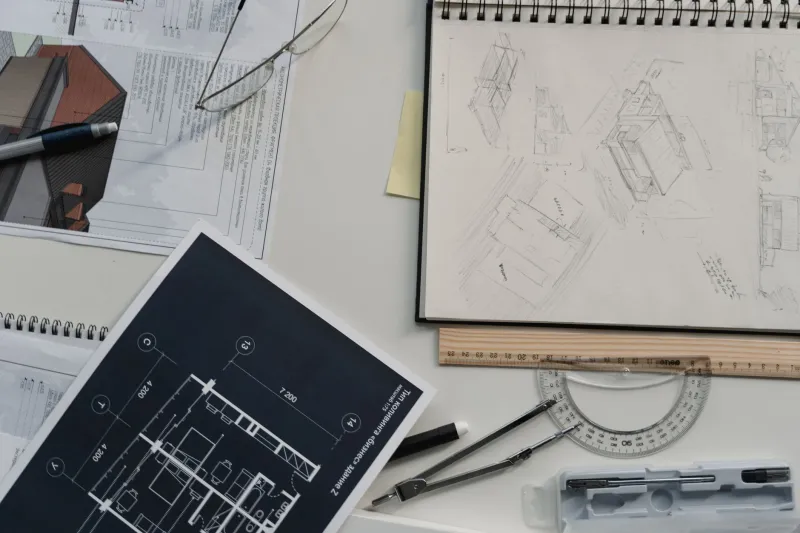
Hand Before Screen: How Leonardo's Sketchbook Discipline Can Restore What Digital Tools Are Quietly Erasing
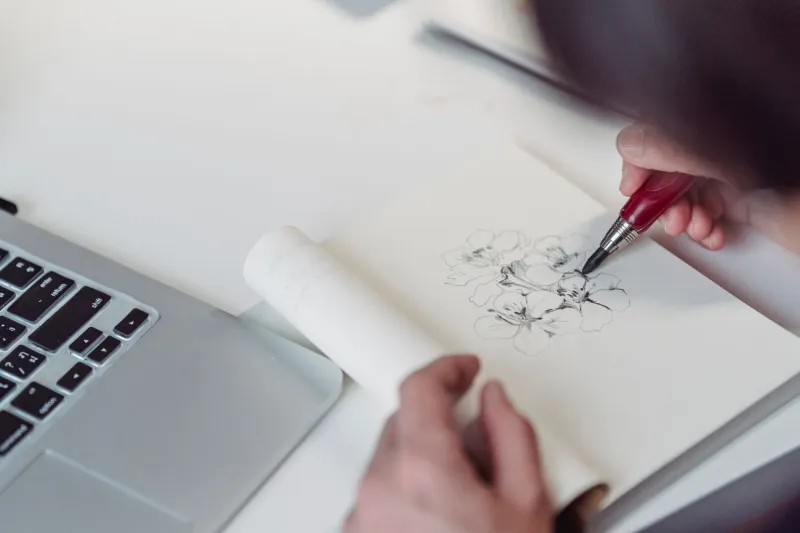
There is a particular kind of thinking that happens only when a pencil moves across paper. It is not the clean, sequential logic of a typed note or a curated mood board. It is messier, faster, and — according to a growing body of cognitive research — considerably more generative. Leonardo da Vinci understood this intuitively five centuries before neuroscientists had the vocabulary to explain it. His notebooks, filled with overlapping sketches, marginalia, and diagrams that seem to chase one another across the page, were not the product of a tidy mind. They were the instrument of an extraordinarily active one.
Today, most American designers, architects, students, and creative professionals reach for a phone or a tablet before they reach for a sketchbook. The gesture is understandable — digital tools are fast, forgiving, and shareable. But the convenience may be costing us something we have not yet fully measured.
The Notebook as Cognitive Engine
Leonardo's sketchbook practice was less about producing finished drawings than about thinking out loud in visual language. He sketched birds in flight not merely to capture their appearance but to understand the mechanical logic of their wings. He drew water currents in swirling, obsessive spirals because the act of rendering motion forced him to perceive patterns his eye alone might have missed. The hand, in Leonardo's practice, was an extension of the analytical mind — but one that operated with a different, often more intuitive grammar.
This is not romantic mythology. Researchers in cognitive neuroscience have documented what practitioners have long sensed: drawing by hand engages the brain's motor cortex, spatial reasoning centers, and visual processing regions simultaneously, creating a form of embodied cognition that screen-based tools do not replicate. When you sketch, you are not merely recording what you see. You are constructing a physical argument about it.
Leonardo's notebooks contain thousands of such arguments — provisional, restless, and frequently abandoned mid-thought. That incompleteness was not a failure of discipline. It was evidence that the sketching process itself had already served its purpose: it had moved the mind forward.
What the Screen Flattens
The smartphone is a remarkable object. It is also, from a perceptual standpoint, a remarkably impoverished one. Every interaction with a touchscreen is frictionless by design. Swipe, tap, pinch — the gestures are smooth, standardized, and deliberately separated from consequence. There is no resistance, no texture, no variation in pressure. The hand learns nothing from the encounter because the encounter has been engineered to require nothing of the hand.
For visual thinkers, this frictionlessness is a subtle but persistent problem. The resistance of paper — the way a pencil drags slightly, the way ink bleeds at the edge of a stroke — is not an inconvenience to be optimized away. It is information. It creates a feedback loop between intention and execution that forces the brain to stay alert, to adjust, to notice. Remove that resistance and you remove a significant portion of the cognitive work that drawing was always performing beneath the surface.
There is also the question of curation. Digital tools, almost without exception, encourage selection over generation. A designer scrolling through Pinterest or browsing a stock image library is choosing among existing visual possibilities, not creating new ones. The algorithmic interface presents options; the user filters them. This is a useful skill. It is not the same skill as starting with a blank page and a half-formed idea and finding out, through the act of drawing, what the idea actually wants to become.
Leonardo never had the option of scrolling. Every image in his notebooks had to be summoned from scratch — from memory, from observation, from imagination. That constraint was, paradoxically, one of the most liberating conditions under which a creative mind has ever worked.
Recovering the Discipline
The argument here is not that digital tools are without value. Illustrators working in Procreate, architects modeling in Rhino, animators composing in After Effects — these professionals are doing genuinely sophisticated visual work. The concern is more specific: that the default has shifted. That sketching by hand, once the foundational discipline of every visual education, has been quietly demoted to an elective, a nostalgic gesture, or a weekend workshop.
Several American art and design schools have begun pushing back against this drift. Programs at institutions including the Rhode Island School of Design and the Pratt Institute have reintroduced mandatory hand-drawing requirements precisely because faculty noticed that students arriving with strong digital portfolios often struggled with the kind of open-ended, generative thinking that sustained creative work demands. The sketchbook, it turned out, was not a historical artifact. It was a training ground for a particular quality of attention.
Leonardo's example is instructive here not as a model to imitate literally but as a standard to recover in spirit. His notebooks were not precious objects — they were working tools, filled with false starts, crossed-out figures, and drawings that bled into the margins. The practice was daily, habitual, and deliberately low-stakes. The point was never to produce a masterpiece on any given page. The point was to keep the hand moving and the eye sharp.
Seeing as a Practiced Skill
Underlying all of this is a claim that Leonardo's entire career embodies: seeing is not passive. The human eye does not simply receive the world; it interprets, selects, and constructs it. That constructive process can be trained, deepened, and made more precise — or it can be allowed to atrophy, outsourced to algorithms that have already decided what is worth looking at.
When a phone camera frames a shot automatically, adjusting exposure and focus before the user has consciously composed the image, it is performing a visual judgment on the user's behalf. When a design app suggests color palettes based on trending aesthetics, it is substituting aggregated preference for individual perception. These are not neutral conveniences. They are, cumulatively, a curriculum — one that teaches the eye to defer rather than to decide.
Leonardo's notebooks offer a counterproposal: that the discipline of looking, really looking, requires friction, time, and the willingness to produce something imperfect in the service of understanding something true. The sketch is not the destination. It is the method.
In an era when the algorithm increasingly precedes the eye, that method may be more urgent than it has ever been. The sketchbook will not replace the smartphone. But it might, for those willing to pick it up, restore something the smartphone has been quietly taking away — the capacity to see the world before deciding how to show it.