Beauty at the Edges: What Leonardo's Grotesque Drawings Reveal About Where Real Innovation Hides
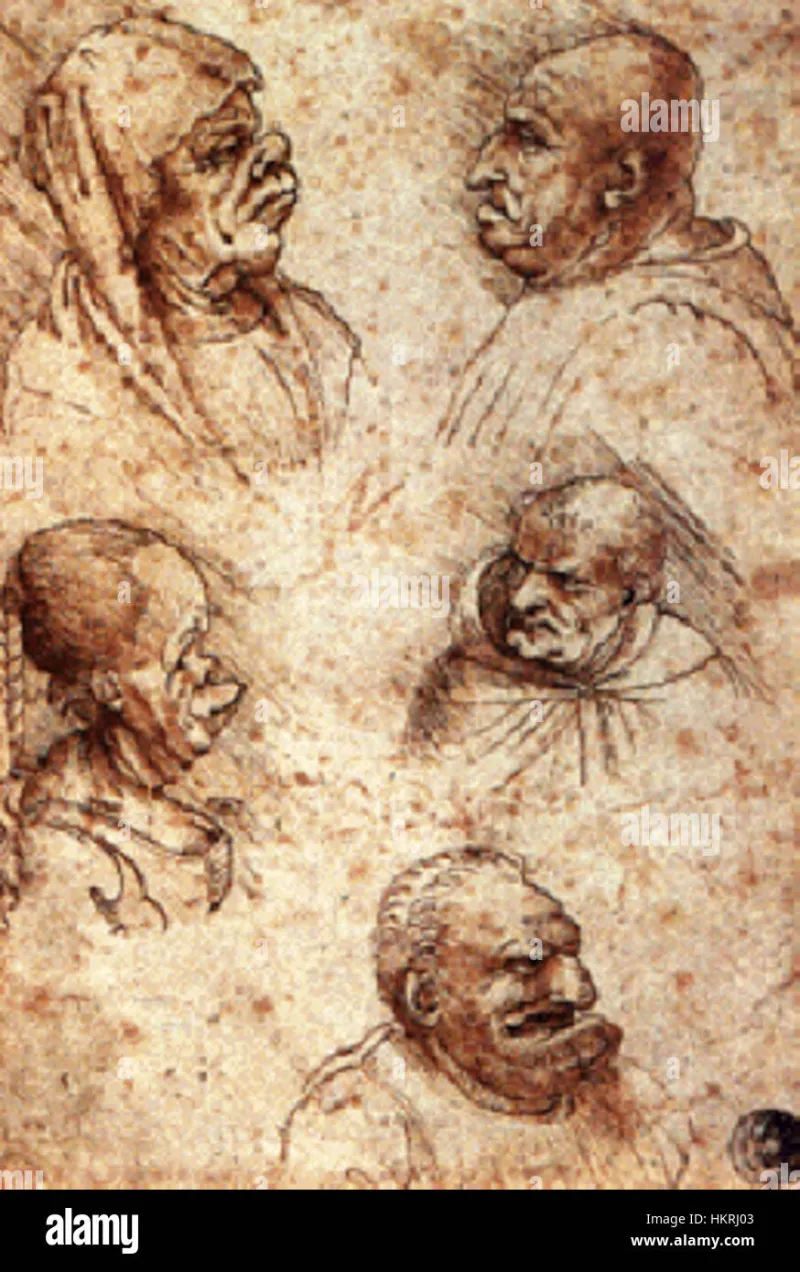
Photo: Renaissance grotesque sketch caricature face drawing old masters study, via c8.alamy.com
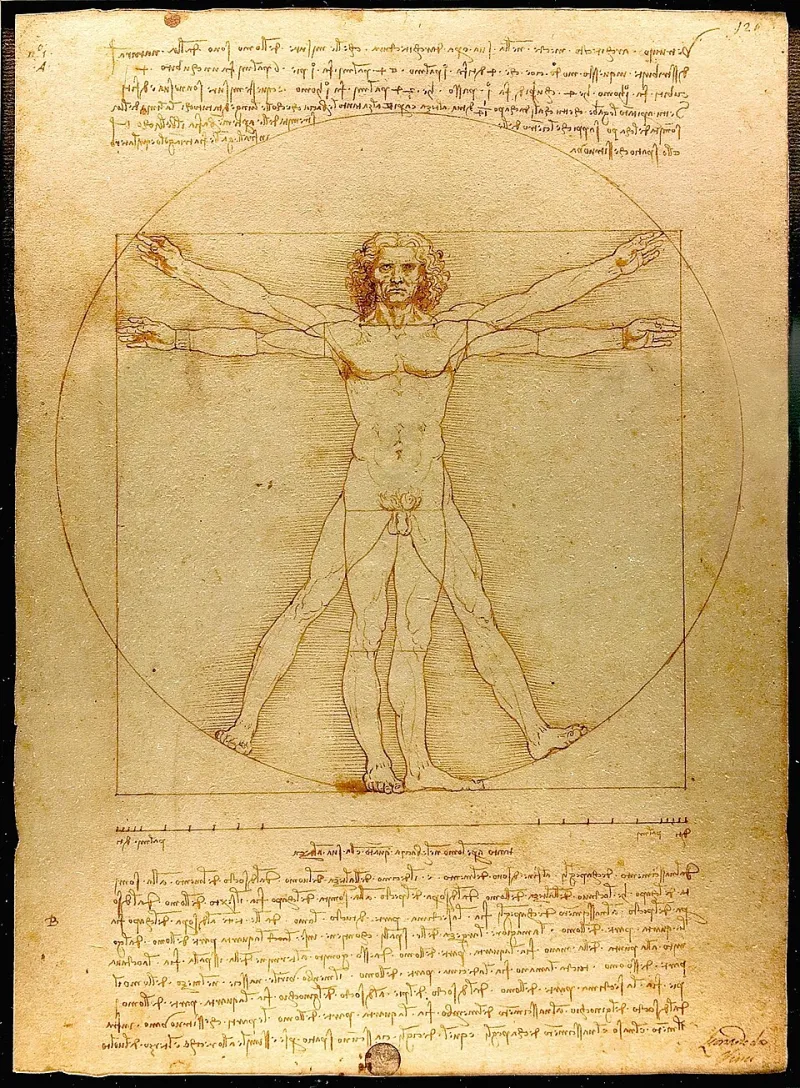
Open almost any survey of Leonardo da Vinci's work and you will find the same canonical images: the serene geometry of Vitruvian Man, the ineffable expression of The Lady with an Ermine, the mathematical perfection of his architectural studies. What those surveys tend to minimize—or relegate to footnotes—are the pages that look nothing like any of that. Pages crowded with warty noses, sunken eyes, jutting chins, and faces so exaggerated they seem to belong to a different species entirely.
Leonardo drew grotesques with the same focused attention he brought to everything else. They were not doodles. They were not jokes. They were investigations.
What the Grotesque Actually Was
The term grotesque in Renaissance usage carried a specific meaning rooted in the rediscovery of ancient Roman decorative art—fantastical hybrid figures found painted in the underground chambers, or grottos, of Nero's Domus Aurea in Rome. By Leonardo's time, the word had expanded to encompass any representation of the human figure pushed toward the extreme, the comic, the monstrous, or the aberrant.
Leonardo's grotesque studies, now scattered across collections including the Royal Collection at Windsor Castle, the Biblioteca Ambrosiana in Milan, and the Uffizi in Florence, typically depict heads in profile or three-quarter view. The features are amplified to the point of near-abstraction: noses that curve like birds' beaks, foreheads that slope dramatically backward, lips compressed into expressions of contempt or anguish or hollow triumph. Some figures appear to be in dialogue with one another, their exaggerated features locked in a kind of visual argument.
Art historians have long debated their purpose. Some read them as character studies for narrative paintings, a library of human types from which Leonardo could draw when populating a crowd scene or a biblical tableau. Others see them as exercises in physiognomy, the Renaissance pseudo-science that claimed to read character from facial structure. Both interpretations have merit. Neither fully accounts for the intensity of attention Leonardo brought to them.
The Outsider as Instrument of Observation
There is a more productive frame, and it requires stepping back from art history into something closer to epistemology. Leonardo's entire investigative method was built on the premise that the most revealing information about any system is found at its boundaries—where normal conditions break down and the underlying structure becomes legible in ways that ordinary examples obscure.
This is why he was as interested in floods as in still water, as fascinated by diseased anatomy as by healthy anatomy, as drawn to aged faces as to young ones. The edge case, the exception, the aberrant instance—these were not distractions from the rule. They were the most direct path to understanding it.
His grotesque studies followed the same logic. By pushing facial features toward their limits, Leonardo was not abandoning the study of ideal form. He was triangulating it. The grotesque face, precisely because it departed so dramatically from canonical beauty, revealed which structural elements were flexible and which were fixed—which proportions could be distorted without destroying recognition, and which, if altered, caused the face to cease reading as human at all.
The Margins as Creative Source
This methodological instinct has a direct and underappreciated relationship to how innovation actually happens—not just in art, but across every domain where new ideas are required to break through established patterns.
In technology, some of the most consequential breakthroughs have emerged from studying edge cases that mainstream researchers dismissed as irrelevant or too strange to be instructive. The development of accessible design—features originally created for users with disabilities—has repeatedly produced interfaces and interaction models that transformed how everyone uses technology. Voice recognition, originally developed to assist users with limited motor control, is now embedded in virtually every consumer device on the market. The margin became the mainstream.
In materials science, the study of structural failures—the ways in which materials deform, crack, and collapse under extreme conditions—has consistently yielded insights that the study of intact, well-behaved materials could not have provided. Aerospace engineers have learned more from catastrophic failures than from successful flights. The grotesque, in this sense, is everywhere.
Leonardo's Outsider Perspective
It is worth noting that Leonardo's affinity for the margins was not purely intellectual. He occupied a marginal position himself. Born illegitimate, denied a formal Latin education, excluded from the learned humanist circles that shaped the intellectual life of Quattrocento Florence, he arrived at his investigations as an outsider who had never been fully socialized into the assumptions of the insider community.
This positioned him, somewhat paradoxically, to see what insiders could not. He was not bound by the aesthetic hierarchies that told a trained Florentine painter which subjects were worthy of serious attention and which were beneath consideration. He drew grotesques with the same rigor he brought to The Last Supper. He dissected corpses with the same curiosity he brought to the flight of birds. The absence of a gatekeeping education was, in some respects, the most important credential he never received.
In the contemporary United States, this dynamic plays out with remarkable consistency across industries. The most disruptive companies in Silicon Valley have often been founded by people who lacked deep experience in the industries they transformed—precisely because deep experience, in sufficiently mature industries, tends to produce sophisticated explanations for why certain things cannot be done. The outsider sees the grotesque where the insider sees only the irrelevant.
What the Distorted Face Teaches
There is one more dimension to Leonardo's grotesque studies that deserves attention, and it is perhaps the most intimate. Many of the figures he drew most obsessively—the ancient, warped, and exaggerated faces that recur across dozens of notebook pages—bear a family resemblance to one another that suggests they were not random exercises but a sustained investigation of a single set of questions.
What is the relationship between physical form and inner life? How much of character is inscribed in the body? Where does the human end and the monstrous begin—and who decides?
These are not merely aesthetic questions. They are questions about power, about who gets to define normalcy, about what gets excluded from the category of the beautiful and why. Leonardo's willingness to sit with those questions—to draw the distorted face with the same care he brought to the idealized one—was itself a form of intellectual courage that his era did not always reward.
At DaVinci Fest, we take seriously the proposition that Renaissance thinking is not merely historical. The grotesque drawings are a reminder that the most important creative breakthroughs rarely arrive from the center. They come, as they always have, from the edges—from the margins, the exceptions, and the faces that don't quite fit the frame.