Sacred Dissection: What Leonardo's Reverence for the Human Body Teaches Us About the Soul of Discovery
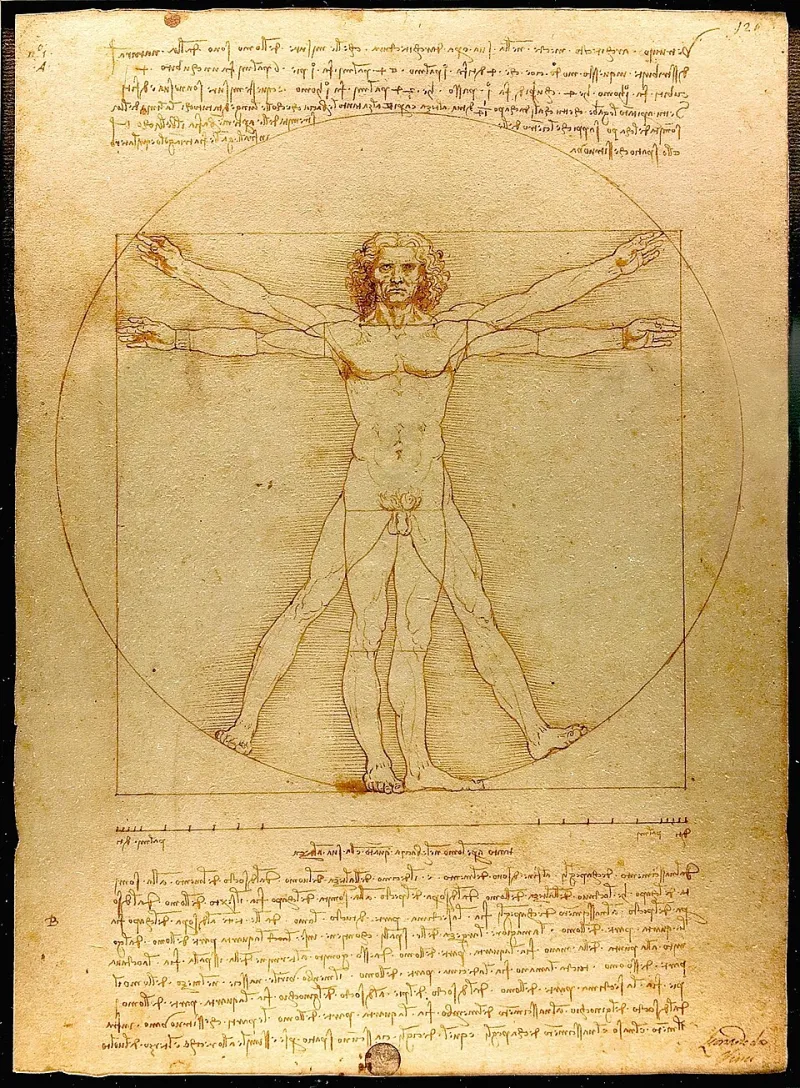
Photo: Leonardo da Vinci, Public domain, via Wikimedia Commons
In the candlelit cellars of Florentine hospitals during the late fifteenth century, a solitary figure bent over cadavers that most of his contemporaries dared not touch. Leonardo da Vinci was not there to conquer the body, catalog it for institutional prestige, or extract information in the manner of a bureaucrat sorting files. He was there, by every indication left in his thousands of surviving pages, because he was overcome by something closer to awe.
This distinction—between knowledge pursued as an act of reverence and knowledge pursued as an act of dominance—may be the most important lesson Leonardo's anatomical notebooks offer a modern American audience increasingly alienated from the deeper purposes of scientific inquiry.
The Notebooks as Devotional Objects
Leonardo completed more than 240 detailed anatomical drawings across roughly two decades of intermittent study, examining subjects ranging from the architecture of the human skull to the precise mechanics of lip movement during speech. What strikes contemporary scholars is not merely the accuracy of these illustrations—though their precision would not be meaningfully surpassed for another century—but the emotional register in which they were produced.
His annotations are not the clipped, impersonal shorthand of a researcher racing toward publication. They are intimate, often astonished, occasionally humbled. Encountering the layered musculature of the shoulder, Leonardo did not write of having solved a mechanical problem. He wrote of having witnessed something extraordinary. The body, in his framing, was not raw material for understanding but a text worthy of lifelong, reverent reading.
This posture toward discovery placed Leonardo in a peculiar position within the intellectual culture of his time. The Church regarded unauthorized dissection with deep suspicion, while the medical establishment of the period treated anatomical knowledge largely as a practical tool for managing illness. Leonardo fit neither mold. He was conducting something closer to a sustained meditation on what it meant to be physically alive.
Science Stripped of the Sacred
American scientific culture today operates under assumptions that would have struck Leonardo as profoundly incomplete. The dominant framework prizes measurable outcomes, replicable data, and the rapid conversion of discovery into application. These are not negligible virtues. But somewhere in the consolidation of research funding around commercial viability and institutional metrics, the posture of reverence—the sense that inquiry itself is a form of participation in something larger than the investigator—has been quietly retired.
The consequences are visible in unexpected places. Medical school curricula that compress the study of human anatomy into increasingly brief modules. Science journalism that frames discovery almost exclusively through the lens of economic utility. A cultural tendency to treat the natural world as a resource to be optimized rather than a phenomenon to be genuinely encountered.
Leonardo's notebooks suggest an alternative epistemology—one in which the act of looking carefully is itself a moral and even spiritual commitment. His cross-sectional drawings of the eye, for instance, are accompanied by reflections on the relationship between vision and the soul. He was not confused about the difference between optics and theology. He simply refused to pretend that the two had nothing to say to each other.
The Cost of Detachment
There is a particular kind of intellectual poverty that results from the relentless professionalization of curiosity. When wonder is systematically trained out of researchers in favor of specialization and productivity benchmarks, the resulting knowledge tends to be precise but narrow—technically accomplished yet strangely incurious about its own implications.
Leonardo's anatomical work suffered from none of this narrowness, and not because he lacked rigor. His drawings of fetal development, for example, demonstrate a level of observational precision that modern embryologists still find remarkable. But that precision was inseparable from the question that drove it: what is the nature of life as it begins? He was not merely describing a biological process. He was asking what it meant.
This integration of the empirical and the philosophical is precisely what contemporary American education tends to discourage. The sciences and the humanities are administered in separate departments, assessed by separate metrics, and funded through separate channels. Students are rarely encouraged to treat the boundary between them as a site of productive tension rather than a bureaucratic convenience.
Reclaiming the Reverent Gaze
The DaVinci Fest tradition of bringing Leonardo's legacy into dialogue with contemporary creative and intellectual life rests on a conviction that his example remains genuinely instructive—not as nostalgia, but as a corrective. The question his anatomical notebooks pose to the present moment is not whether we can match his precision. We can, and in most technical respects we have surpassed it. The question is whether we can recover his disposition.
Reverence, in the context of scientific inquiry, does not require religious commitment. It requires only the recognition that what is being examined matters—that the phenomenon under study is not merely data to be extracted but a reality that deserves to be met with something approaching humility. Leonardo brought this quality to everything he investigated, from the flight patterns of birds to the hydraulics of the human heart.
American culture is not without resources for reclaiming this orientation. The tradition of natural history, at its best, has always combined rigorous observation with genuine wonder. Certain corners of the environmental sciences maintain a relationship to the nonhuman world that echoes Leonardo's reverence for the body. Contemplative practices drawn from both Western and non-Western traditions offer frameworks for disciplined attention that do not collapse into mere data collection.
What is needed, perhaps, is a more deliberate cultural conversation about why we pursue knowledge in the first place—and what we stand to lose when the answer becomes purely instrumental.
The Body as Testament
Leonardo never published his anatomical findings. The notebooks circulated privately and were largely forgotten until centuries after his death. In one sense, this represents an enormous loss—a delay in the progress of medical science that might have been avoided. In another sense, it is a reminder that his investigations were never primarily about dissemination. They were about encounter.
He dissected the human body not to own its secrets but to be changed by them. That distinction, subtle as it may appear, marks the difference between knowledge as extraction and knowledge as transformation. It is a distinction that Leonardo's legacy—carefully preserved, carefully examined—continues to press upon anyone willing to look closely enough.