The Left-Handed Cipher: What Leonardo's Mirror Script Teaches Us About the Creative Mind
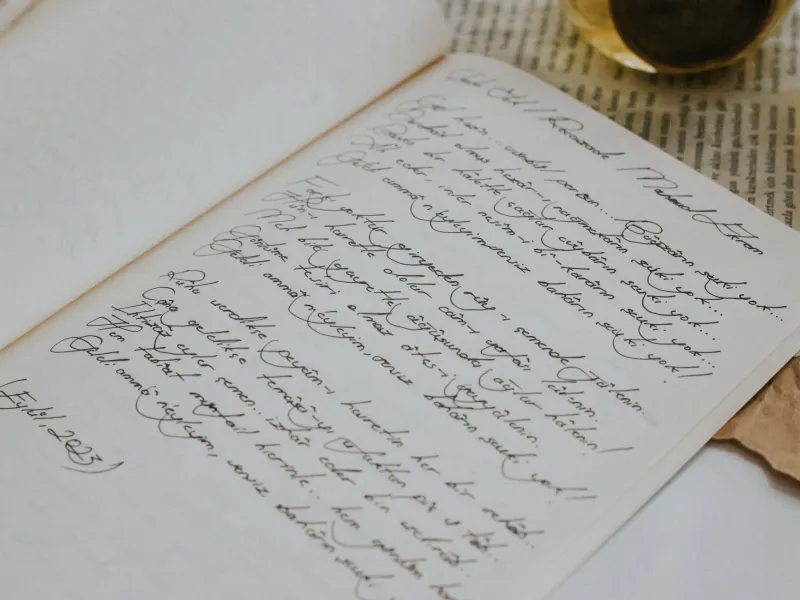
Imagine receiving a letter written entirely in reverse, each word a reflection of itself, the text flowing from right to left across the page like a river running the wrong way. Now imagine that the letter contains, in no particular order, anatomical dissections of the human shoulder, a recipe for a blue pigment, three variations on a mechanical gear system, and a shopping list. This is, more or less, what it is like to open one of Leonardo da Vinci's notebooks.
The mirror writing is the first thing most people notice. It is also, paradoxically, the feature that has most consistently distracted scholars from what the notebooks actually contain. For centuries, the backward script has been treated as a puzzle to be solved—a clever code, a neurological quirk, a deliberate act of concealment. The more interesting question, however, is not why Leonardo wrote in reverse. It is what his entire system of note-taking, of which mirror script is just one element, reveals about the architecture of an extraordinary mind.
A Script That Runs Against the Current
Leonardo was left-handed, a fact that was socially inconvenient in Renaissance Italy, where left-handedness was frequently discouraged, if not actively suppressed, by schoolmasters and clergy. For a left-handed writer using a quill pen and iron gall ink, writing from right to left presented a practical advantage: the hand moved away from freshly laid ink rather than dragging through it, reducing smearing on the page. This is the most straightforward explanation for the mirror script, and it is almost certainly part of the story.
But it is not the whole story. Leonardo was a man of extraordinary deliberateness. He chose his materials, his methods, and his compositions with evident intentionality. The consistency and elegance of his mirror script—maintained across decades and thousands of notebook pages—suggests a practice that had become both habitual and purposeful. Several Leonardo scholars, including Martin Kemp of Oxford University, have argued that the script also served a protective function: in a competitive intellectual environment where ideas were intellectual property without legal protection, writing in a form that required effort to decipher was a reasonable safeguard against casual plagiarism.
The notebooks were, after all, never intended for publication. They were private working documents—a laboratory of the mind—and the mirror script was, in part, the lock on the laboratory door.
The Notebook as a Non-Linear Mind
To understand what Leonardo's note-taking system truly represents, it is necessary to set aside the assumption that a great thinker's records should be orderly. Our cultural bias toward systematic organization—the indexed binder, the color-coded outline, the linear argument—is a relatively recent imposition on intellectual life, one that owes more to the printing press and corporate productivity culture than to any natural law of cognition.
Leonardo's notebooks violate nearly every convention of organized thought. A single page might contain a detailed mechanical drawing, a fragment of a poem, a note about the behavior of water in a curved channel, and a sketch of a man's profile—all without apparent connection, all executed with equal precision. Marginalia crowd the borders. Sentences begin and do not finish. Diagrams are annotated in multiple directions. The overall impression is of a mind that refused to think in sequence.
This is not disorganization. It is a different kind of order.
Cognitive scientists who study creativity have noted that many highly original thinkers exhibit what is sometimes called associative thinking—the tendency to perceive connections between seemingly unrelated domains. Leonardo's notebooks are, in a very real sense, a physical record of associative cognition in action. The proximity of a mechanical drawing to a botanical sketch is not accidental; it reflects a mind that was constantly searching for structural analogies across disciplines.
Fragmentation as Intellectual Strategy
One of the most counterintuitive aspects of Leonardo's note-taking practice is its deliberate incompleteness. He rarely finished a thought in the conventional sense. Observations are recorded, then abandoned mid-sentence. Designs are sketched to a certain point of development, then superseded by a revised version on the next page. The art historian Kenneth Clark once wrote, somewhat despairingly, that Leonardo was a man who left everything unfinished.
But there is a compelling argument that this incompleteness was strategic rather than symptomatic. By leaving conceptual threads open, Leonardo maintained a state of sustained inquiry. He was not trying to arrive at conclusions; he was trying to remain in the productive state of asking questions. Modern researchers in the psychology of creativity, including Mihaly Csikszentmihalyi, whose work on the concept of "flow" has influenced everything from educational theory to workplace design, have identified this sustained questioning state as a hallmark of highly creative individuals.
Leonardo's notebooks, in other words, were not a record of what he knew. They were a tool for continuing not to know—for keeping problems alive, malleable, and open to revision.
Protecting Ideas Before Intellectual Property Existed
The question of intellectual self-protection is worth examining more closely, particularly for an American audience accustomed to thinking about patents, trademarks, and copyright as fundamental features of the creative economy. In Leonardo's era, no such formal protections existed. Ideas moved freely—or were stolen freely—depending on one's perspective. A workshop assistant who observed a master's technique could reproduce and sell it without consequence. A rival court could commission a copy of an innovative machine design without attribution or compensation.
Leonardo was acutely aware of this vulnerability. His mirror script, his fragmented notation, his habit of recording only partial specifications for his most sensitive mechanical designs—all of these practices can be read as a Renaissance-era intellectual property strategy. The information was preserved, but in a form that required significant effort, expertise, and perhaps personal acquaintance with Leonardo himself to fully decode.
This is not paranoia; it is pragmatism. And it raises a question that remains urgent in the contemporary moment: how does a creative mind protect the value of its ideas in an environment where reproduction is effortless? Leonardo's answer was to make the ideas inseparable from his own cognitive fingerprint—to encode them in a system so personal that they could not be extracted without losing something essential.
What Modern Productivity Culture Misses
In recent years, the language of productivity has colonized discussions of creative work in ways that Leonardo would likely have found baffling. Bullet journals, Zettelkasten systems, second-brain methodologies, and digital note-taking applications promise to impose structure on the chaos of intellectual life. These tools are not without value. But they rest on an assumption—that the goal of a creative note-taking practice is to produce retrievable, organized, actionable information—that Leonardo's notebooks directly contradict.
The notebooks were not a productivity system. They were a thinking environment. The distinction matters enormously. A productivity system is designed to move information efficiently from input to output. A thinking environment is designed to create the conditions in which unexpected connections can occur—in which the proximity of a mechanical sketch and a botanical observation might suddenly illuminate something that neither, examined alone, could reveal.
For intellectuals, artists, and innovators navigating the demands of contemporary professional life, Leonardo's notebooks offer an alternative model: one in which incompleteness is not failure, non-linearity is not disorganization, and the most valuable intellectual property is the one that cannot be easily reproduced.
Reading the Mirror
Holding a page of Leonardo's mirror script up to a reflective surface and watching the reversed text resolve into legibility is, even today, a quietly thrilling experience. Something that appeared opaque becomes transparent. A private language becomes, momentarily, your own.
That experience is, perhaps, the best metaphor for what the notebooks as a whole offer. They are not a record of conclusions but an invitation to look at thinking itself from an unfamiliar angle. To read Leonardo's mirror script is not to decode a cipher. It is to encounter a mind that understood, five centuries before the rest of us caught up, that the most important ideas are the ones that resist easy translation.
At DaVinci Fest, that resistance is precisely what we celebrate.


